In the world of Evandar, the gods are very active and meddle directly in the affairs of humanity. Some treat them as their servants. Others treat them as their children. And some consider humanity to be nothing more then game pieces to be moved about the board. The gods of the desert and the habitable places within it fall between the position of humanity as their servants and as their children.
The stories of the people of the desert region vary pretty widely about the origins of life. They speak of all things coming into being by way of a goddess, though the exact method of creation is different for each major social group. Some of the oldest tales of the deserts talk of the land once being green and fertile before it was blasted by an angry god. In almost all of the tales of the Waste (the desert upon the continent where Evandar is situated) this angry god is described as the 'black one' or otherwise associated with darkness.
This is another manifestation of the Evandari god of suffering and evil, Morguthu. The primordial goddess is a manifestation of Roen, the Evandari mother of all life. The solar deities are generally male but occasionally genderless, with the capacity to appear of either gender. This latter is a blending of the Evandari gods Sigurt and Kaileth. As one moves through the desert lands, they will find at the very least the trio of cognates to Morguthu, Roen, and Sigurt. There are, however, other minor deities who watch over the people and lands of the desert. Some of those minor deities are quite powerful, such as Ashur the Dacian god of the desert.
The peoples of temperate regions have the base quartet of cognates to Roen, Sigurt, Kaileth, and Morguthu. From region to region, however, there are additional gods who preside over different aspects of life. These additional gods are argued by some to be the children of the first four. Some, however, argue that they are all equally powerful. It is tempting to say that these different deities are of human invention compared to the quartet that are so prevalent through out the world. This, however, is inaccurate.
These other deities (minor or not) do exist and are powerful in their own rights. The deities of the world of Evandar know of each other and interact with each other. Intense rivalries develop between them and equally intense alliances. The gods of Roen, Sigurt, Kaileth, and Morguthu are, however, the eldest of the deities of Evandar. Just as Roen has demigod children by Sigurt and Morguthu, so to do other deities. Their demigod children, however, have a different relationship with humanity then those of Roen's line. The demigods of the different pantheons tend to stay within the geographical region of their believers, though some have traveled beyond those regions.
The only thing that is consistent through all the faiths of the world is that in ages passed, there was a war between the gods and the great god of evil. This war was fought by men and demigods with a great deal of casualties. Entire peoples were lost as a result of that war. Signs of their doomed civilizations lie scattered through out the world. Now, however, signs of that ancient war renewing are appearing through out the world. Evandar is but the center most location of this conflict. And like that ancient war, all pantheons will turn their might against the god of evil in his many guises for the sake of preventing the utter destruction of the world.
Friday, April 3, 2015

Wednesday, March 25, 2015
Of Lions and Eagles
The priest-king Marcos sat at his raised chair and looked at the flame of the lantern before him. Like the other priests of Ashur, he was learned in the meanings and ways of the storms that blew off of the desert. When Zalaz told him how the sky had turned a pink color and that there had been no signs of a coming storm earlier in the day, Marcos turned quiet. None of the timidness that plagued his actions as ruler of Dacia remained as he gave orders that the palace be shuttered against the storm and word of the color of the skies was given to the other priests of the desert god. Shortly after the first shutters were set, the winds began to blow and the fine grit of the leading edge of the storm came flying with them.
The servant that Marcos had sent to the temple of Julara ventured out dressed against the storm though it had not fully broken. Zalaz was fairly certain that in the city, people were scrambling to secure their homes against the storm. He thought of Yaeli and found himself concerned that she was safely within the house rather then in the gardens. His concern for his favorite concubine distracted him for a moment from the preparations being made about the chamber. The door where Marcos's mute guards stood opened.
A small man dressed in dusty clothes accompanied by a tall man dressed in clothes that were only slightly less dirty entered. The scarves that they had worn across their faces hung down around their necks. Behind them, the high priestess of Julara, the goddess of the fertile fields and the life giving rivers, entered dressed in her black gown and double veil. Where the men she walked with bore evidence of the storm on their clothes, Mina looked untouched by the winds and sand.
Mina lifted the outer veil, a gauzy thin fabric that shielded her eyes from the flying sand, and looked at Marcos. As she lifted the inner veil, Zalaz could see the look of concern on her face. Where the priestess had always seemed utterly calm and composed in public, Zalaz found himself relieved to see her more human response to her husband's urgent call. The tall man unwound his head scarf, revealing sandy blond hair, pale skin, and eyes of a shade of green that Zalaz had only seen in the captive great cat that resided in the royal menagerie. The blond man looked over at dark eyed and dusky featured Zalaz with his expression of concern turning to suspicion.
Zalaz noted how the man kept his sword arm free even as he took the scarves off, giving them to a servant. With a small nod of approval, the general watched as the blond man gave the room a quick scan for possible threats. Again, his unsettling eyes fell on the general where he sat on the bench awaiting them. Zalaz rose to his feet and walked over to where Mina and Marcos were engaged in quiet conversation. The blond man stood near them, careful not to appear to be too close. Zalaz wondered how much of a struggle that bit of deception was for him.
“Blessed Lady,” Zalaz said, giving Mina a deep bow, “I stand ever in your service.” Mina looked at the general and wondered what news he had brought. A part of her feared that Zalaz brought their deaths upon his blade. At her right, Sorenan stood ready to draw his weapons and put himself between the general and the couple. Zalaz stood still and waited for Mina to acknowledge him.
“What news is so great that it brings you personally to this chamber? What reason have you called for me?” Mina said, disregarding a formal expression of acknowledgement. Zalaz straightened. He looked Mina in the face and saw the mixture of concern and wariness. In the chamber that held only Marcos, his most trusted servants, and themselves, Zalaz realized that they anticipated nothing but trouble from his presence.
“I bring your liberation,” Zalaz said. For a moment confusion crossed Mina's face and then her eyes widened slightly as she realized what he was saying. All of Mina's schooled poise faltered as she brought her hands up and covered her mouth. Her small gasp of amazement told Zalaz that she had not anticipated his support. Amusement at the fact that he surprised the far seeing mystical eyes of the priestess and avatar of Julara rose up at the back of his mind. Zalaz pushed it aside. He turned his gaze to the man known as the Lion of the North.
Sorenan regarded him suspiciously. “I speak truly,” Zalaz said, “I bent the council to my will and have secured Marcos freedom from their hold.” Sorenan frowned slightly. “It is whispered that you are an experienced soldier,” Zalaz said. Sorenan nodded. “Good, we will have need of your eyes going forward,” Zalaz said as he turned his gaze back to Marcos, “I have begun the process of raising the army. All able bodied men who are of age will be pressed into service, save for yourself. As king and emperor, you are the greatest of all of us and the sword bearer of Ashur.”
Marcos paled a little at Zalaz's words. Zalaz moved his gaze over to Sorenan. “You can appoint a champion who will march in your stead,” Zalaz said, “One who will serve as your hand and will wield the weapons for you.” Zalaz looked back at Marcos. “I advise you send someone whom you trust completely and has combat experience.” Mina dropped her hands and shook her head slightly. An all too human look of dread crossed her face.
“We can not do …” she started when Sorenan reached forward and set a hand on her shoulder. Mina looked over at him, her expression of dread turning to grief. “You will be …” she began and Sorenan interrupted her. Zalaz was surprised by this, for he had never seen any interrupt the high priestess of Julara.
“As sword-bearer of Ashur,” Sorenan said quietly, “what must I do?” Mina shook her head. Sorenan looked over at her. “Enemies stand all about you,” he said solemnly, “Marcos can send armies to meet their forces, but someone must stand before them. He is emperor but he does not have the skill with arms to lead them into battle. This is no different then my journey into the north.”
“That was supposed to be a peaceful message,” she said, “your place is here to advise.” Marcos reached over and took Mina's left wrist in his hands. She looked down at him. “Tell him,” Mina said, “Ashur would not send him from us.” All of Mina's efforts to hold her pragmatic, stoic response to the dangers that had built up against them were failing as the reality of it sank in.
“Ashur has come with Zalaz,” Marcos said, “He speaks in the wind. This is fate and the will of him.” Mina shook her head. “Ashur guards Julara,” Marcos said, “He protects her from the dark one. He would use any man that he sets his hand upon. It rests heavily on Sorenan. You can not deny that.”
“But it is the words of men that say he must go,” Mina said. Sorenan sighed. Zalaz watched the trio and held his silence. Mina's fear, he realized, was not a lapse in faith but rather the anguish of a woman sending her man off to war. “It is the words of men that say you must bear the sword,” Mina said, “You can send others to act as your agents. Zalaz himself would stand in your stead. He has the experience and wisdom to do it.”
Marcos reached over and took Mina's hand in both of his. He looked up at his wife with a regretful expression. “No,” Marcos said quietly, “It is the will of Ashur. My brothers come to confirm what Ashur says in the wind.” Moments later, the doors of the chamber opened and a knot of uneasy priests came in conferring quietly amongst themselves. Marcos looked over at them. He knew with the certainty of his bones and blood what they were going to say. He had listened to the winds of Ashur as they blew about the building. He heard the voice of his god clearly in them.
Though Marcos had feared men, he trusted Ashur. It was Ashur who had lifted him up from obscurity. It was Ashur who spoke to him in the storm that came during the selection of who would wed Mina. In the storm and the winds that blew off the desert, Marcos had always heard Ashur's voice. Where it had before advised him of how to rule and how to perform the rites, it spoke now of war. Ashur's anger was in the storm and giving it its fury. “Wipe them from the earth,” Ashur's voice said, “Take arms and drive them into the dark one's domain.”
The priests looked at Marcos with fear in their eyes. “Ashur speaks in the storm,” the eldest of them said, “He speaks of war. He speaks of enemies bearing blades against you. The winds command you to …”
“Take up arms and drive them into the black sands of the south,” Marcos said, finishing the man's sentence. The priests looked between themselve and at Marcos. “Ashur commands me to arms,” Marcos said, letting go of Mina's hands and looking at Zalaz, “The eagles of the desert must be fed by my hand.” Mina shook her head in denial. “As you raise your army,” he said to Zalaz, “teach me what I must know.” Zalaz frowned.
“A few months of training will not make up for years deficit,” he said. Marcos nodded.
“Ashur will make my arm strong and my blows true,” Marcos said, “He will give his sword bearer the power to wield it.” Zalaz looked at Marcos and noted for the first time that there was no uncertainty in the emperor's bearing. A look of unearthly calm was on his face. It was an expression that Marcos had worn in his priestly duties and the presence of Ashur was strong.
“And your third?” Zalaz said. Marcos looked over at Sorenan who watched him with a mixture of amazement and concern.
“He shall guard Julara's daughter when I am away,” Marcos said.
“You can not go,” Mina said.
Marcos turned to her. “It is Ashur that sends me and will keep me in his hand,” Marcos said. “It is he who commands this, not I,” he continued. A deafening clap of thunder came at the conclusion of Marcos's words. The priests looked fearfully upward. Sorenan instinctively reached for his weapons just as Zalaz did in his surprise. Mina's expression became one of despair. “The eagles of the desert shall fly and bear the storm on their wings,” Marcos said, unshaken and untroubled by the thunder.
Upon saying this, the room was filled with a heavy, eerie sense of some greater presence amongst them. Marcos gestured towards the open doors out into the antechamber. “Behold Ashur,” he said. All eyes turned towards the door. Standing in the doorway was a shadowy figure that appeared to be an armed man with an eagle upon his shoulder. He raised his right hand in a gesture of summoning. Then the figure disappeared with a whirl of dust through the antechamber despite it's tightly shuttered windows.
The priests gave cries of fear. Zalaz stared at where the figure had stood with a mixture of awe and terror. Behind him, Sorenan was speechless. Where the others had not seen the face of Ashur, Sorenan did. That face he saw was an amalgamation of his own and Marcos's. The gesture of summoning was accompanied with a voice in his head. It was a low male voice. “Stand at my side,” it had said.
Sorenan looked over at Marcos with a new respect. The voice was terrifying and seemed to hold the fury of the greatest winds in it with the roll of thunder. Once, Marcos said that Ashur's voice was that of the storm. Sorenan thought it just some saying to impress others. Having heard the voice of the desert god, Sorenan realized that Marcos was not the soft thing he had thought him for so long. The mercenary realized that Marcos stood fully in the presence of the possessor of that voice at all times and somehow continued his life with out being crushed by it.
“He spoke,” Sorenan said breaking the silence.
“Yes,” Marcos said, looking over at Sorenan, “He summons you to stand with him. You are to also be a sword-bearer. It is the bearers of swords who stand with Ashur.” Zalaz's blood ran cold. Marcos looked to him. “And through them he will give his messages,” Marcos said, gesturing towards the sword at Zalaz's side. “So it is done,” Marcos said.
Mina covered her eyes with a trembling hand. All her anger, all her plotting, and all her will could not stay the tears or the fear that washed through her. Never had she felt so fragile, so small, or so helpless before the will of the gods. The ringing sense of comfort that breathed through her as she served Julara abandoned her in that awful moment. For in that moment, she was not the living embodiment of Julara's mercy and wrath, but rather a heartbroken woman. And she wept.
Exciting news!
The hardcover edition of The Dragon's Daughter is now available for purchase. If you buy through Lulu.com, you will get 10% off. The e-book version will be available soon.
The Dragon's Daughter is book one of the Umbrel Chronicles of Evandar. This is a series that tells the story of the events surrounding the wars of gods and men set in the world of Evandar. Book two is on the editing bench and I'm making good headway in getting it ready for beta readers.
A few folks have asked when the prequels to The Dragon's Daughter will be coming out. I am still in the midst of working on them. I hope to have the rough draft of the first book of the trilogy finished by late autumn of this year. I am currently engaged in developing character sketches for figures that will be featured in these three books. If you are interested in being featured as a character, fill out my questionnaire and e-mail me.
Fellow Authors please note:
If you are interested in writing fanfiction or collaborating with me on short stories set within my little world, contact me. I will be happy to feature your work on this blog and give links back to your work and/or blogs.
I hope you all have a wonderful day!
Thursday, March 12, 2015
Purple prose, flowery language, and idioms.
Perhaps one of the hardest parts of creating a culture whole cloth is developing their language. While one could go the route that the esteemed J.R.R. Tolkien did and develop their language from the very basics of syllables and lettering, it is equally difficult to describe how people within your newly minted world speak on a casual basis. In a fantasy world that is in no way connected with Earth, one finds themselves adrift with out the expressions that anchor casual conversation. To say that someone is "against the clock" when they are attempting to complete something as fast as possible by a deadline does not make sense in a world with out clocks.
There are many other little expressions that we use in our daily lives that we pay no mind to. These idioms are more then linguistic habits. They are a cultural shorthand for ideas that, at times, are strictly ingrained in said culture. A statement such as "a ball-park figure" become nonsensical when removed from the culture they originated in. Thus, authors who are creating a world that lacks these cultural elements are forced to develop new idioms that take place within the context of their world. This is not an easy task.
Idioms express many things and have shades of meaning that can be different given the intonation of the statement, the context of it, or any number of additional secondary meanings that are divergent from the original idiom and the meanings of the words that create it. It is, however, not a task that is insurmountable. With a little planning and careful consideration, one can transform an expression that is commonly used in our world to something for the fantasy world but still recognizable.
For example, within the kingdom of Evandar, an expression that is comparable to 'devil take it' is 'darkness take it'. The statement is used in the same context that 'devil take it' would have been in an Earthly conversation and carries much of the same weight. After a little exploration, the expression 'darkness take it' is revealed to speak of the abode of the god of evil and says that this deity should lay claim to that which this pejorative is declared against. Where the difference between the two expressions lies in a single word, it changes considerably and takes on a different dimension within the fantasy world.
It is a time consuming task but it adds greater depth of realism to the fantasy world. Nothing is as jarring as encountering anachronism in a historical novel or something that is blatantly of Earth in a novel that is entirely focused on a world that has no contact with ours. I exhort you, my fellow writers, to dive into your world and take the time to build idioms. While you may not be building an entirely new language, the idioms become an important part of creating the suspension of disbelief that a truly great novel has. Our readers deserve nothing less.
Upon the death of Sir Terry Pratchett
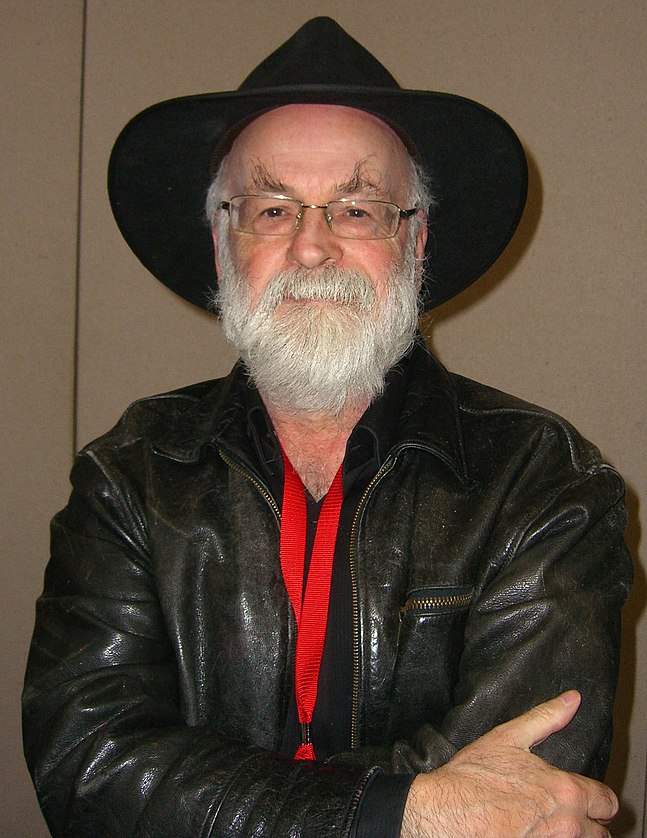 |
| Image from Wikipedia |
I think, however, Sir Pratchett would not be pleased with the mourning that much of the fanbase and writerly community is entering into right now. He was a man with a great deal of anger at the injustices in the world. He was a man who used his novels as a vehicle to attempt to effect change in the world through the spreading of ideas. I suspect that Sir Pratchett would be furious to see hand wringing and flowery eulogies.
I believe, my friends, that the best way we might honor this man's truly impressive legacy is to pick up our pens and get to work. If we are not writers, that does not mean we escape the call to work for change in the world. Sir Terry Pratchett was a man who used his gifts to push the world towards being a better place, a more just place. Let us honor him not with tears and rituals of mourning, but with our honest effort to continue his fight to make this world a better place.
Friday, March 6, 2015
The High Council of Dacia
General Zalaz stood before the council
dressed in his blood red linen tunic with the purple and gold sash at
his waist that bespoke his rank at the highest of the generals in the
empire. Beneath that sash, the dark leather baldric held his sheathed
sword. That long, gently curving blade had drunk the blood of many
and was rumored to be blessed by Ashur himself. More then the sash,
the sword spoke of his authority. Gifted to him by the last emperor,
the spouse of the previous high priestess of Julara, it was shocking
austere in its apperance.
Where the others in the council
chamber would have kept such a gift aside and worn it only for
official purposes, Zalaz used the weapon with great ferocity on the
field of battle. Standing before the council, Zalaz found himself
wishing that the matters could be settled by combat. With his strong
right arm and his trusty sword, Zalaz knew he could defeat any
comers. This, however, was not a battle of weapons but rather words.
Silently, Zalaz damned his fate that moved him from a mere soldier in
the field to a political figure.
The council members were of varying
ages but all bore a measure of softness in their bearing that
disgusted Zalaz. These politicans were not people who would have
survived the vigors of Zalaz's life, though with their lofty
attitudes they seemed to assume that they would by virtue of their
title. The fat man sitting at the extreme right of the semicircle of
the chamber spoke nasally of the prices of grain and how disappointed
he was that the taxes were not raking in as much as he desired. The
wan light filtering into the room gleamed off the man's bald head and
hilighted the deep shadows in his face from the folds of fat about
it.
They knew that the general had
something of importance to discuss. They, however, felt that he was
unfit for their company. His long hair and stern disciplined life
struck them as unnatural. The way he lived with his concubines,
specifically Yaeli, disgusted them. They were of the mind that all
women but for the silent sisters and the priestesses of Yulara were
beneath them. The general's favorable treatment of his concubines ran
too closely to treating them as equals. This, the other council
members, believed could never do.
Thus, when Zalaz did not take his
customary seat at the far left seat of the council dias, they decided
to ignore him until he did. Quietly, Zalaz waited. Inwardly, his
anger was rising. He knew the council would decry the situation that
Marcos was in. He suspected that they'd argue that the priest-king
should be executed and then insist that someone else be installed in
his place. He suspected, also, that they would focus upon the problem
of Marcos rather then the danger that the sons of Omaurath presented.
Zalaz had thought about the situation
in the last two days. His nights had been sleepless, much to the
concern of Yaeli, as he struggled to think of what to say to the
council. As he considered the situation, he came to the conclusion
that the danger of the sons of Omaurath was far greater then what he
initially thought when they began to be discussed years ago. The fact
that they had gone to Selath in search of aid for their cause told
him that the accord was going to break. Zalaz had no questions that
the govenor of Selath would send word to his superiors and eventually
the king of Tamna. Tamna had long sought to win the fertile plain
between the great rivers and the wealth of Dacia.
Zalaz learned from his predecessor, a
general named Tuvius, that Tamna had repeatedly attempted to gain
access to the western cities of the empire. The capital, sitting at
the meeting of the fertile lands with the desert was unfortunately
vulnerable but there was no ways that it might be moved for it was
the very place where Julara and Ashur came together. There were
cities farther west of Dacia but they did not have the strength of
the cities in the floodplains. Zalaz was fairly certain though those
cities would fight hard, they would fall before Tamna's armies. Zalaz
knew they stood on the edge of war. And yet the council bickered and
flattered themselves, ignoring him as he stood before them.
Unable to stand there silent any
longer, Zalaz's anger burst forth with a single cry. Bellowing with
all the volume he used to order his troops on the field, Zalaz's
voice was deafening in the sandstone chamber. “Silence!” he
roared. Shocked silence filled the room as all eyes turned to him.
Zalaz noted with some disgust that almost all of the faces had some
measure of fear in them. Deciding that he could use that fear to goad
them into action, Zalaz said in a quiet growl, “I have word from
the king and emperor that we are on the edge of war and yet you would
continue to ignore me because I have stood before you rather then
taken my seat. You will listen to me and a judgment will be made.”
In the minds of his listeners, the
vague fear that Zalaz could send assassins into their midst
crystalized and the soft men of the council trembled. Their arrogance
faded before Zalaz's anger, for he had always been quietly spoken and
courteous. This unexpected change of demeanor made them fearful. They
had waited for him to turn on them and now they feared it had
happened. So caught up in their fear, they missed the first words of
the general's statement. Only the word war cut through their fear and
served to heighten it at the same time.
“General, we are civilized men,”
the boldest of them, an elderly man with hands that trembled,
started. Zalaz's expression darkened and the man nearly fourty years
his elder fell silent. Zalaz looked at each of the six men sitting
before him. He could feel a headache building as his anger at their
simpering behavior came to full force. They had denied that the
armies of Dacia required more funding, insisting that there were no
threats. They said that the accord with Selath was a sign that Tamna
was an ally and to be a trade partner by how quickly it was signed.
They argued that the army was better served policing the trade routes
of bandits rather then preparing for conflict. Now, that conflict
stood on the horizion, as Zalaz had warned for the past several
years.
“Civilized men,” Zalaz said,
“Civilized men, you say, Althas. Tell me, old man, how does a
civilized man deal with broken treaties and an army coming to his
door?” Althas's watery grey eyes widened at Zalaz's low,
threatening tone and the horrible words he said. “The sons of
Omaurath are raising an army as we speak. They are courting Selath
and the kingdom of Tamna as we speak. The northern reaches of the
empire are coming under regular attacks by the tribesmen of the
mountains. The bandits that you have worried about interrupting your
trade routes have become more organized due to the influence of
Omaurath's three sons and the raider Althar, who moves into alliance
with them in the hopes of dividing Dacia between the four of them for
their own kingdoms. And yet, you declare that you are civilized men
and ignore me when I have come to you with word of these movements.”
Althas started to open his mouth to
argue with Zalaz when the man sitting to his left placed a hand over
Althas's trembling hand and shook his head. The old man closed his
mouth and looked at Zalaz. “I require a force of arms sufficient to
defend Dacia in the immediate future. This means conscription. I will
draw from all families. Men will be put to work according to their
measure,” Zalaz said. Another man, sitting at Althas's right,
opened his mouth to argue. Zalaz pointed at him as his expression
turned thunderous.
“Do not argue against me, Zafar,”
he ordered, “Your vineyards will be burned to the ground as Tamna
moves through. Your women will be captured and your servants will be
slaughtered, if not enslaved. You, of everyone on this council, stand
to have the greatest amount to lose, for sitting in the west of the
empire. It is in your best interests to approve what I propose.”
Zafar paled as Zalaz described what would befall his lands and
property. As he fidgeted with a jeweled necklace that he wore, Zafar,
looked uncertainly at the others. Zalaz turned his bright gaze upon
the other men in the chamber.
“All of you stand to lose more then
your wealth,” Zalaz continued, “When the armies come into Dacia
city, they will sack the city. All men will be slaughtered, even the
priests of Ashur. The women will be raped, captured, and enslaved.
Children will be killed down to the least babe in arms. All your
wealth will not save you. It will be the reason why you are among the
first to die.”
Shaken the council looked between
themselves. “Give me the means to defend Dacia and the emperor
freedom to do as he will. Release him from the ancient binds that
require him to consult the council so that he might have the
opportunity to take council from his generals and actually win this
war that is coming.” One of the younger council members coughed.
Zalaz looked over at him.
“We can not do that,” he said, “It
is tradition that dictates our...”
Zalaz's expression contorted with
fury. “It is tradition that digs all our graves,” he roared, “It
is your blind adherance to the words of your fathers that keeps us
from being prepared for this. Your fathers would not want you to
destroy the very lands they bled for. It is spitting in their faces
to do so.”
Shocked silence reigned.The obease man
who had been complaining about his tax revenue raised his right hand.
It was a silent vote in affirmation of Zalaz's demands. After a few
minutes, two more hands joined him. Althas and Zafar exchanged a
troubled look as the man sitting beside them raised his hand. “I
have a majority,” Zalaz said darkly, “I could force the vote.”
Althas frowned.
“We don't know for sure...” he
started when Zalaz stepped forward. Althas went quiet and leaned back
in his seat, as though Zalaz's hand could slay him from several yards
away. “It is with reluctance, I vote...” he began as he started
to raise his hand. Zalaz glared at him. Zafar locked eyes with Zalaz.
A silent battle of wills took place. As Zalaz set his right hand upon
his sword in a silent threat, Zafar paled and raised his hand.
Zalaz turned sharply on his heel. As
he started to stride out of the chamber, he noted the scribe doing
his best to not be noticed. “You,” he ordered, pointing at the
man nearly cowering, “Send word through the city that I am calling
my men to me. And make it known that all able bodied men are to
prepare themselves for service in the army. I expect by sundown that
all of Dacia city will be aware of this. And riders will be sent out
into the empire.” The troubled scribe bowed deeply to Zalaz, not
daring to raise his head until the general had left.
As Zalaz made his way to the palace,
some of his anger cooled. While he had secured for Marcos the freedom
to take this man Sorenan into his union, the general also knew that
he had the means to secure the rights to command all the armies in
all but name. He walked up the steps into the palace, noting that the
skies had taken on an almost pink tinge though it was still hours
before dusk. “Ashur comes at my heels,” Zalaz muttered, “I
don't know if this is a good omen or not.”
He walked into the chamber where
Marcos saw his officials. Marcos's dark head was bent low as he
conversed with a scribe and read the document. It was an uncommon
thing that Marcos could read, but it made sense with his history as
having served as a scribe in his life before rising into priesthood.
Zalaz strode through the long chamber and stopped a few feet away
from where Marcos sat on his raised chair. Zalaz cleared his throat
and the two men looked up. Upon realizing that Zalaz was standing
before him, Marcos said in a ringing, “Clear the chamber. I have
private business to discuss with the general. Any who listen in will
be punished, severely, am I understood?”
The various servants and petty nobles
that sought to bask in the presence of the emperor made their way out
of the chamber. The two guards who stood at the main entrance into
the room followed the attendants out of the chamber. Zalaz fixed the
guards at the secondary entrance into the chamber behind Marcos with
a dark glare. Knowing who Zalaz was looking at, Marcos said, “They
can stay. They can not repeat what is said here. They are mute.”
Zalaz looked back at Marcos.
“You are freed from consulting the
council at all times and at liberty to do as you will,” he said.
Marcos looked at him in amazement. “You will pay my debt,” Zalaz
continued. There was none of his earlier anger in his words, only the
dry tone of fact. Marcos swallowed.
“What would you have of me? I, who
owe you all,” Marcos asked. Zalaz looked Marcos in the face with an
appraising look. Though Zalaz knew that Marcos lived a pampered life
and was not half so bold as himself, he suspected that he had steel
within him yet.
“You will follow my orders in the
movements and actions of the troops,” Zalaz said and Marcos's eyes
widened. “If I tell you that all males over the age of twelve are
to take military service, then you will put that word through out the
empire as a decree. If I tell you that the cities of the west are to
be abandoned, you will order it. The sons of Omaurath and the kingdom
of Tamna move towards war. You know it as surely as I do. You know
that the forces to the north will need little convicing to join them.
I want to see this war won, with the sons of Omurath and their
supporters feeding the vultures.”
Marcos swallowed and looked a little
green. He nodded, however. “I can not go against Mina,” Marcos
said. Zalaz's expression was solemn.
“We will require the blessings and
the witchcraft of the priestesses of Julara,” Zalaz said, “I
would not expect you to do otherwise. I wish to speak with her and
your … third as soon as possible. We have much to discuss.”
Marcos nodded. Somewhere within
himself, a knot of tension uncoiled. For the first time since hearing
about the rumors and considering the prospect of facing the council,
Marcos felt something of hope.
Sunday, March 1, 2015
The dirty side of medieval-esqe life.
Something that regularly irks me in fantasy novels that are set in medieval settings is the fact that they whitewash the world. This happens a lot in romance novels set in this period too. Enough so that it had become a running joke between my best friend and I, with her reminding me that castles were warm and cozy and I reminded her that heroes always had to be muscular males (which always made her laugh because she was in a gay relationship when this conversation came up and we were trying to determine what the ideal hero was supposed to be). The whitewashing of the dirtiness and generally disgusting parts of the past and settings that are based in it is a type of romanticism that I think the genre could do without.
One thing that I actually like about the A Song of Ice and Fire series (Game of Thrones is the first book and the title of the television show based off it.) is the fact that Geo. R.R. Martin does portray the ugliness of the world. He doesn't try to pain his setting as one that is free of the attendant difficulties of that period. In keeping the more unpleasant aspects of that era in the picture, he adds a greater level of realism to his work. Yes, we can tell someone that a peasant lives in a hovel with their animals. Unfortunately, the image that comes to mind is a clean dwelling with clean animals that basically stand around and look pretty. When the truth is the dwelling is going to be dirty from what the animals track in and if they void their bowels or bladder indoors (which had to happen from time to time just on the basis of probability and statistics). The truth is that the dwelling was poorly lit and poorly heated. The truth is that there were rodents in the rushes that thatched that hovel and rodents scurrying around in the living area of it as well. A peasant's hovel was not the clean pretty thing you see in children's books.
And castles had their share of problems. The list is a bit too long to slap up here but a cursory bit of research into how people lived in castles will show you that they were also dirty places and were terribly heated. It would tell you that they were dark because they were poorly lit and lacked natural light. It would tell you many, many things that would put all but the hardiest of medievalists off from the idea of wanting to stay in one for a night, let alone live in one. (For the record, I am one of those hardcore medievalists.) They were nothing like what Peter Jackson portrayed in the Lord of the Rings movies. The people were not half so clean and well fed. The list of ways that the fantasy stories get the history wrong is too long to present here and that's really not my goal.
I want to make a case for presenting all that ugly stuff. Every story requires a conflict. Too often, it is assumed that the conflict must come in the actions of characters opposing each other. When we look at history, we see that there is lots of conflict in the story of these people's lives. It came from their environment. It came from if they had the bare necessities for survival. It came from the dangers that were present at all times, be it those of rancid food (because food preservation was nowhere near as advanced as what we had in the 1800s, let alone today) or illness. I'm not talking about something as dramatic as the Black Death. Influenza killed people in those days. A bout of bronchitis could (and most likely did) prove lethal all on its own. Then incorporate the medical technology of the era and illness becomes even more horrifying. A simple case of the common cold could possibly kill you if you weren't lucky.
Some would say that conflict coming from things like the dangers of using an open pit latrine or food poisoning are not as interesting as the conflict that comes from two characters fighting. I would argue that in the hands of a skilled author, even a case of the common cold in modern times can become a conflict that would interest the audience and advance the plot of the story. I would furthermore argue that not taking these factors into consideration is doing yourself and your readers a disservice. It is messy and depressing to read the history of the eras we base our material in. The trade off of this work, however, is creating a world that draws your readers into the story.
That, my friends, is one of the goals of writing a book. We don't just want our audience to passively look at the words on the page and come away with a dry sense of what the story was about. We want to draw them into the story and present human elements that they can connect with. We want to have our readers come away from our stories having gained something. A good book may tell a technical marvel of storycraft. It may be an exemplary example of sentence construction and how to organize material on the page. All of that technical skill, however, falls flat if your reader is not engaged in the story. Take the time to write out the dirty details of the world your characters move in. It makes the experience more believable and real to the reader. And that will increase your chance of moving the reader to emotion and the imaginative envisioning of your story. The more senses you engage your readers in, the more they will remember your book.
Subscribe to:
Posts (Atom)