Showing posts with label Commentary. Show all posts

Saturday, September 27, 2025

AW:Morning Pgs 2025: Day 29

 Hello dear Reader,

Part of my silence has been because I've been busy off line with a ton of stuff. More of it has been fear. I was afraid that my blogs would be shut down because the content wasn't inline with the christo-facist bullshit being peddled by the government. When I realized that was the root of my silence, I got mad. I was almost angry enough to throw things. I took an Xanax and did some deep breathing to calm myself down. My anxiety medication is a blessing and works very well. (Have I mentioned that my anxiety has been just about off the chart for months now?)

I am not going to let fear of being deplatformed stop me. I have always spoken out against villainy and oppressive bullshit. I am going to become a bit more political in my posting here. Look for that content in my morning pages. I may lose readership over this. Honestly, it can't be too many more than how much readership I lost by not joining X after Elon Musk took over Twitter. Or the readership that I lost by just not writing for a little over a year. I don't care much, either way, to be frank.

I am quite likely going to cross post this entry on my other blogs. It's a bit lazy but it saves me from typing out the same message several times. I am going to attempt to resume daily themed posts starting tomorrow. I've been pushing myself to be up and moving in the morning around the time my youngest child heads off to school. My anxiety medication kicks me in the teeth and I often take a nap after he gets on the bus, but if I'm lucky, it'll only be a short one and I'll be moving around and doing stuff at 9am. 

Wednesday, January 24, 2024

First attempt highlights: AW: Reading Notes - Spiritual Electricity and the Basic Tools.

 This really is all that I wrote regarding my notes on this book. Then 2019 turned into chaos which continue into today.

AW: Reading Notes 1

I will be revisiting the two chapters discussed in this post in the coming weeks.

Monday, July 24, 2023

There's a murder on my lawn.

 Dear Reader,

One of my Beloved's favorite type of birds are crows. There's a small murder on the lawn pecking at the cracked corn he scattered all over the place. It's been interesting to watch the birds while I'm stuck in writer's block. I have started looking over past posts in this blog to see what loose ends I can pick up and start working with again. The first one that stood out to me was the critical analysis of The Artist's Way by Julia Cameron. My feelings towards this book are complicated. The first time I read through it, I found it highly inspirational and a source of encouragement. Subsequent read throughs, I started finding problems in it and places where Ms. Cameron is socially blind to the limitations of people who are disabled and who have financial security problems. I don't think this is intentional per se, but rather a case of someone of a certain social standing assuming that others have access to the resources that they did. 

To say this more bluntly, I don't think Ms. Cameron can envision a person attempting to write a novel on paper napkins that came with their takeout order, because they don't have access to anything else to write on. I had the good fortune of not being in that place, but there are many who are. Some people have the reaction of 'pish, a composition notebook is just a few bucks.' But when your budget is tight and that composition notebook sitting in your shopping cart is needed for your child who is going to start school in a few weeks, you don't pick up a second one because it will cut into how much you have to get that damned expensive graphing calculator that's perilously close to breaking your budget.

And then there is the question of time. A philosopher will tell you that time is infinite. A physicist may agree and have some fancy equations to prove it. But our lives are finite which means our time in this world is finite. People love to quote that we weren't born to pay taxes and die. But if you're working a grueling job and taking care of your family, including some relatives outside your household, you are going to have a hard time finding the time or the energy to write a few poems or sketch some doodles in a notebook. And quite often the people in this position are also on the super tight budgets because they're living paycheck to paycheck and praying that they're going to get a tax return to help pay off the car.

Just as people have the reaction that you can afford a cheap notebook, there are people who say if you simply organize more and use the latest fad organizational system then you will magically have time for your artistic inclinations. The closest to that which you are going to find me endorsing is creative time management. While dinner is cooking in the oven, take that 45 min time to work a little on your chosen craft. Allow yourself to skip leg day if it's healthy to do so and take an hour to do some kind of creative work. Also remember, creative work is more than cranking out art like some kind of machine. It requires fuel/food in the form of exposure to other's work. So, that cheezy romance novel that you read to keep yourself from smoking during your cigarette break at work is helping to fill the well of ideas even as it keeps you occupied for 15 min.

As Beloved has put it to me: how do you eat an elephant? one bite at a time. Each small task that you do towards your creative work is a victory against all the distractions. Stolen moments and creative engineering of your resources leads you to where you are engaged in the great work.

Thursday, June 23, 2022

Editing is like pulling hen's teeth.

 Dear Reader,

I am currently working on line edits for a book in the Umbrel Chronicles of Evandar series. It is slow going and exhausting. I have discovered places where one character wound up with three different names. I have found typos galore. It isn't pretty. And this doesn't account for the fact that I still have to reformat the page size and type font for the entire document. 

Some of you may say, "Deb, why don't you hire an editor?"

The simple answer is that I'm broke. The extra money that could have gone towards getting this professionally edited and proofread is going towards my son's braces. It's the same reason why I haven't done anything like those nifty book trailers that you've seen on Facebook or paid for advertising. I just don't have the cashflow to make it happen. It forces me to sit down and go through a document a good six or seven times before I deem it ready for publication. It can take months, especially when my depressive episodes sap my ability to think clearly.

At one point, my mother-in-law told me how I needed an agent. She was convinced that if I had an agent that one of the big traditional publishers would be interested in my series of books. I mean, it's not everyday that someone says "Hey, we've got the first third of a thirty book series right here and it's not half bad. We just need to put it to press and slap a better cover on it." The problem is, since I have gone independent publishing, they want to see big purchase numbers before they are even remotely interested.

I don't have big purchasing numbers. I'm a small fish in a big ocean in a market that's rather glutted. It requires me to push advertising and the money for that is going for household needs and my kids' needs. If I won big ticket lotto, maybe I'd throw money in this direction. I don't know. By now, editing myself is a habit. Finish writing a book, set it aside for a few months, and then start the long process of edits and read throughs. I've gotten halfway decent at it, despite the word processor's attempts to correct my spellings and such.

I am very 'type a' about my writing. It is part of the reason why I am an independent author. I want that creative control over pretty much everything. I've heard horror stories from some traditionally published authors about how the manuscript got butchered in the editing and formatting process until it no longer resembled what they wrote. It happens a fair amount of time from what I have heard. I may not sell well, but I am telling the story that I want to tell. Not something that is watered down and filled with hype oriented concepts that will make it more 'appealing'. It's a measure of freedom that I don't think I am going to give up. Authenticity in my writing is the most important thing right after making sure that I get character names right and I clean up all the typos.

Thursday, November 15, 2018

Excelsior ad infinitum.

Dear Reader,

If you are a nerd like me, the recent death of Stan Lee may have you feeling dismayed. Mr. Lee's work inspired countless artists and authors around the world. His work was passionate and filled with life. From all accounts, Mr. Lee was a gentleman and a great friend to his fans. I aspire to be half as influential and inspirational as Stan Lee. As much as we may argue if the movies were better than the comic books and quibble over which character is better, I think we can all agree that the real hero was Stan Lee and his infinite genius.

He created characters and stories that excelled at both entertaining us and informing us as to something about the human condition. His work tackled cultural issues with as much vigor as they entertained us. It is my sincerest hope that what ever afterlife Mr. Lee is welcomed to, he is greeted with as much joy and has as much joy as he has given the world with his life's work.

Excelsior ad infinitum.

Wednesday, August 10, 2016

Craft of Writing: Bonus Post - Mental Illness in Characters.

Hi folks!

Below in all of it's bad grammar glory is something I posted on Facebook. I'm not typically one to cross post stuff from Facebook on my blogs because I'm not comfortable translating things from different platforms. This, however, is one of my exceptions. Before I share it, though, please allow me to provide some context.

In a writer's group I'm apart of on Facebook, a discussion arose as to how to create a truly scary antagonist. Several people bemoaned the difficulty of providing a good scare when so much seems to be based in viewing fear as directly proportional to the amount of gory violence detailed. (Which is a reasonable complaint that is especially valid with respect to the visual medium such as television or movies.) Somewhere in the course of the discussion, someone tossed out how sociopathy is a 'scary' concept.

Sociopathy as a 'scary' trait is a heavily over used trope, in my opinion. It has become short hand for saying that a character is a villain, along with things such as bipolar, mania, and schizophrenia. This trope is so prevalent that it is accepted as common knowledge and bandied about in the media as an explanation for things such as mass murder. I have a justifiable hatred for this trope. It comes from multiple things. But, I think that this bit that I am cross posting from Facebook makes my position clear, so let me present it now.

i prefer it when the sociopath trope is turned on its head. when the hero is one, things get much more interesting in my opinion. 

also, the argument that they are inherently amoral is not really a good one to go with. there is a significant number of people in the general population who have a sociopathy diagnosis that are not dangers to society. they do tend to be very stoic and their reasoning as to why something is appropriate or not tends to be based on logic or a code of honor they choose to adhere to rather than emotion.

honestly, the idea of using mental illness as a stock trait for your antagonist can be slipshod and poorly done if you're just going to plug in what you find on the internet describing symptoms instead of building the character so that their symptoms are not their only 'scary' quality. stereotyping mental illness as the prime motivator of a villain's behavior is piss poor writing, in my opinion, and only furthers the negative stigma that people in the real world face as suffering from mental illness. it is just as bad as making your villains of an ethnic minority simply because you need to shoehorn in a minority character and some how provide an additional dimension to your character.

now, mental illness CAN be a very powerful factor in an antagonist's motivations and scare factor but it requires a degree of sensitivity to things such as how mental illness effects all parties in a situation. exquisite horror can be written showing how your sociopath character is suffering due to their illness with out removing the horror of their deeds. i can tell you that the fight with your own mind is just as terrifying as having someone directly threaten your life, especially when it is a 24-7 experience with no relief.

also, another reason to consider showing your antagonist's suffering from their illness is because it humanizes them and effectively forces your reader to view them as a person rather than a straight up monster. this plants that seed of identification with the antagonist which makes the horror of what they do that much greater because a part of the reader is forced to envision themselves enacting it.

tl:dr - mental illness does not equal good villain. please tread carefully, do your research, and make it one of many identifying traits rather than the primary trait that marks them as an antagonist. failing to do so makes it harder for people with mental illness IRL.

Tuesday, November 3, 2015

And so it begins.

I have been working on book six for a few weeks now. With the start of NaNoWriMo, I've been a little extra focused on it. It is hard to get good writing time in with small children in the house. The act of disciplining myself to sit at the desk and work while they are at school has been hard for me. Over the last few days, however, I have been making progress. I have just about 10k words to show for about 8 hours of work. My goal is to get my hourly word count higher. Adjusting to the keyboard on this laptop has been a bit more challenging than I thought.

Still, I am at work and trying to get the story written out before the holidays hit in full force. I think the biggest challenge I am facing right now is resisting the temptation to screw around on Youtube and Facebook. Twitter hasn't caught my fancy quite as strongly as the other two. I am sure, however, at some point in this process it will prove as much of a time sink as the others.

Aside from the difficulties of staying on task, I have been slowed down some by the fact that I have to go back through the previous five books to make sure that everything for the scenes and characters match up properly. I think I lost about an hour today to just making sure I had three characters written correctly. I really should have started my note card system with the first book. It would have made this so much easier. I suppose it is something I can do once I get this manuscript finished.

As of this evening, my word count is standing at 20210. I may be able to eek out another one thousand words if I stay focused until it is time for me to head to bed. I lost count how many cups of coffee I had today. Maybe I'll start keeping a tally of that. Until tomorrow, I wish everyone taking on NaNoWriMo and NaBloPoMo the best of luck. Remember, you're not competing with anyone but yourself. And the word count is less important than telling the story.

Saturday, September 19, 2015

Inspiration.

I find inspiration in many places. Right now, it is a bit hard to come by. I think that is due to the combination of stress and brain fog from my allergies. Usually, music is a really big source of inspiration for me. I like to listen to soundtracks of movies and classical works. I have a love of the romantic period Russian composers. I also find inspiration in contemporary music. I am saddened that E.S. Posthumus is no more. Apparently, this was two brothers working together to produce electro-classical works. One of the brothers died and that was the end of E.S. Posthumus.

Taking walks, I sometimes have ideas pop into my mind or solutions to plot problems arise from seemingly nowhere. I highly recommend the practice of taking a daily stroll. It is great exercise and has a lot of health benefits. But the thing I really love about them is the way I always come back from a walk with new ideas for something to write. I wish I had more picturesque surroundings to walk through, like I did when I was growing up on the farm. Still, I have the lake near by and this little town we live in is generally pleasant.

I wish I could say that my children inspired me. It is less that they inspire material as much as they provoke strong emotions which become expressed through my writing. Some days, I am filled with deep love and happiness. Most days, I find myself rather frustrated. By purging my frustration on the page, I find myself having a better grip on how to parent. I suppose everyone needs an outlet for those feelings and mine happens to be the written word.

Pictures and reading about different places in the world (and different periods of history) have always been an enormous source of inspiration. Dacia, the empire that I have a serial I'm working on here, is based in a fantasy version of the empires of Babylon and Assyria. I've taken some liberties with how things are structured and such. At the same time, however, you can see those roots if you look hard enough. I like to draw details from history of our world into my writing because it makes it a bit more meaty.

In case you haven't noticed, I prefer my fantasy with a heavy dose of realism in it. By basing material on existing facts within our world, I make it easier for someone to suspend reality long enough to enjoy the story. I figure because I absolutely love this experience, I should share it with you, my readers. I find visceral pleasure in the well written word and expertly crafted stories. I aspire to reach the same level of skill as authors like Jacqueline Carey. Their lush worlds, vibrant characters, and clever plots draw me in and have a mesmerizing hold on me. Reading is my escape just as much as my writing is. And I hope to make it a pleasurable escape for you, my readers.

Friday, September 18, 2015

Random thoughts.

I have been struggling with allergies all week. The Benadryl has not been doing much for my itchy eyes and uncomfortable sinuses. It has lead to my not being as productive as I wanted to be. As much as I hate winter, I look forward to the time where my allergies will be alleviated by the blanket of white everywhere. I have, however, been thinking quite a bit.

I have a new laptop. As I am getting familiar with it, I find myself considering naming it and at something of a loss for what that name should be. I was worried at first because I couldn't find the word processing software and thought I had to download something. Then, after some tinkering, I finally found it and played around with it a bit. It seems to be just like Word, which I have been using for all these years when I am not writing out things longhand. I think my next logical step, before I start pounding out some serious writing with it, should be to acquire a thumb drive. I'm not sure what brands are good, so if any of you, my readers, have suggestions, please let me know in the comments.

I spent a large portion of this week cleaning up my project room. I now have a work space where I can sit with my laptop and work with out distractions. I will confess, in addition to my laptop, I have an assortment of pens which includes three dip pens (and bottles of ink), six felt tipped calligraphy pens, and two fountain pens with interchangeable tips. As I was going through my pen collection, I had mixed feelings. On one hand, I really do love writing with these pens. At the same time, I feel like I need a good set of cheap but smooth writing ball point pens. I've been looking at the Pilot G3 pens at the local Walmart and moving towards buying a small stock of them.

With my uncovering my writing space and where I had hidden my lovely, lovely pens, I also discovered yet another notebook relating to a large writing project. It is the first one that I started to record ideas for the Sanctuary series in. I don't have a lot in there, but it is good that I found it because my other notebook is getting quite full. I am in the middle of working on revising the first book of the Sanctuary series. I don't feel as confident with that one as I do with the Umbrel Chronicles because the different genre. Still, I keep feeling the push to write it, so I have been. I am trying to decide if I will publish that under a pen name or not. When I have things more settled with that series, I will let you know more about it.

I have started the process of drafting out and plotting book seven of the Umbrel Chronicles. Editing books three and four has been slow and somewhat difficult going. I have been finding quite a few errors and correcting them. The major parts of the story, however, remain intact and that is something that I am pleased with. I have yet to begin the revision process on books five and six. They are in the 'mellowing' period where I let a manuscript rest before I come back to it and start revisions. I like to let a manuscript sit for around half a year so that I can come back to it with fresh eyes. It slows down the production process, I suppose, but it makes for a better quality result.

One thing that I do know, however, is that book seven will be longer than the previous books. I found myself writing to a word count (50k approximately) that has come to feel too arbitrarily short. Sure, I can tell a story in 50k words. My six books give evidence of that. I feel, however, that I am stopping in the middle of the action. Editing has only reinforced this feeling that I am stopping short of where I need to be. So, this time, I am going to write until the story tells me it is finished. I don't know if it will be 50k or 100k words when I stop, but I'm not going to worry about it. I am just going to focus on following the wisdom of Earnest Hemingway and 'Write the truest sentence you know.'

Monday, August 31, 2015

Something On the Side.

When I am not immersed in my own writing, I do a lot of reading. I have a bit of a back log of books to type up reviews for. It is my hope with the beginning of school next week, I can get those finished up and possibly resume my old habit of typing up reviews as I finish up books. If you are interested, check out my Livejournal account. Here is the link to my latest review: http://cydira.livejournal.com/34943.html

If you have any suggestions for books I should review, let me know either in the comments on my posts or with an e-mail. I hope everyone is having a lovely day.

Wednesday, August 26, 2015

Work space!


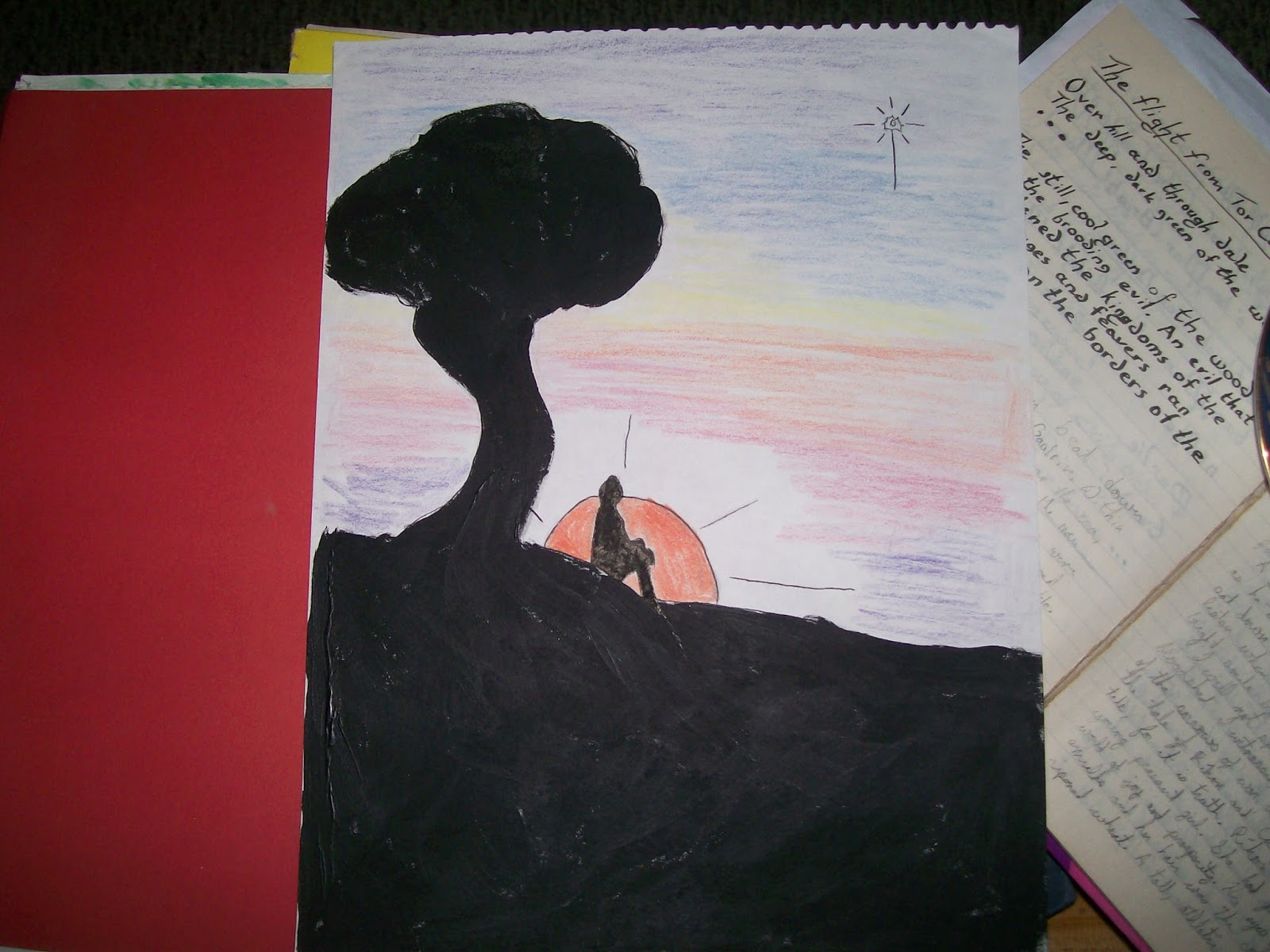
In preparation of getting down to serious work in two weeks (because when the boys go back to school, I'm getting cracking on writing stuff), I am gathering up all my notes and supplies. Pictured to the right is my stack of notebooks and folders. Along with all of that written word, there is my trusty cup of coffee which powers my work and one of several mixed media works I have made based on my little world.

The notebook that my coffee is sitting on is falling apart, as the gap in the binding can clearly show up. It is the oldest of my notebooks. I sat down and realized that that notebook turns 20 this year. It was a sobering thought. I have been keeping notes and writing shorts set in this world for almost half my life. I handle that notebook gingerly because it is so prone to falling apart. It has pages falling out, other pages with notes on them shoved into it, and the binding one step away from disintegrating. Still, it is probably the most important of my notebooks. In here is the core of my world building. In here is the details of the story the entire series is going to tell. Yes, they are rough details, but they are written down and therefore precious to me.

The stack of five folders on the left holds the things I had written up on loose leaf paper. The red folder immediately below the picture holds my maps and actual sketches of persons and scenes in the stories. The folder beneath that has the rambling efforts I have made over the years to develop some kind of language for the elfin people and the rudimentary attempts to flesh out a magical system. I haven't done much with that material in the last two years. It was put aside for safe keeping but I have reached the point now that I need to blow the dust off and dig into that work.

The third red folder down beneath the picture has the disorganized material I developed while going through college. Working on my education full time, it made my efforts to work on this stuff challenging. But, somewhere in the midst of it all, I found time to do a series of pictures based off of stuff. Here's a better shot of a nameless protagonist watching the sun set at the edge of Dragonwoood Forest. I did this in 2000.


Thursday, August 13, 2015

Office Supplies? YES PLEASE!

It is back to school season. Office supplies are priced dirt cheap to get you in the stores to buy things in bulk for people going back to school. While I am not excited about getting school supplies, I am a little giddy with excitement about acquiring more things to use in my world building. One of my major things is doing idea work long hand. Hence my stack of notebooks and new file card system.

I don't go so far as sniffing that new marker smell, though I know a few people who do. But my little heart goes pitter-pat over those virginal notebooks, the plethora of pens, and all the organizing supplies I could need. I have to go shopping with a list so that I don't get carried away buying things. It makes me feel a little silly to confess this, but I suspect that there are plenty of others who do the same thing.

In my most recent office supply shopping foray, I picked up some sticky tabs to create your own tab divided notebook. As I have been working on organizing all of my back story stuff in to something I could work from more easily, I realized that dividing my material up into their own sections in the notebooks would probably work out exceptionally well for me. I thought about getting a five subject notebook, but I'm not fully decided on that yet.

I realize, however, that to truly make my organized system work, I will have to copy over material from the other notebooks into the new ones to their correct location. It looks like it will be a lot of work to do it by hand. Honestly, a part of me says I should just type it up, but it is a concept that just feels wrong. I admit it, I do a great deal of my writing on the basis of how it makes me feel. I suppose you could to some extent call my writing method emotionally driven. I learned at college, however, that using organizational methods that don't feel appropriate ends in very poor quality of work for me.

My pile of notebooks and journals has been growing again because it is that time of year. The hyper-critical part of my brain decries my collecting of notebooks, journals, and pens as a wasteful thing to do. The rest of me hogties that part of my brain and throws it into the dark basement where even the lone light bulb doesn't work, and then I get on with my work.

Thursday, August 6, 2015

Organizing Chaos.

Some authors don't go out and make tons of notes and plans for their books. The NaNoWriMo community lovingly calls them 'pantsers' ie writing by the seat of your pants. Then there are writers like myself who are referred to as 'plotters'. We make outlines and notes of all the details of what we want our book to look like. Some of us only do a rough outline. Others are meticulous and almost look like their final work is a matter of rearranging notes into the correct tense and doing a little window dressing.

I've written works as a 'pantser' and it was an interesting experience. Honestly, I can't say I hated the process but it was very frustrating. I'm still editing that work and finding 'bugs' in it. Two months of writing, in this case, has equaled approximately two years in editing, thus far. Like I said, it was frustrating and the effects still are somewhat frustrating. It was a thrill on the days that work flowed freely from my fingertips to the keyboard. I can understand the allure of that form of "no net, high wire" writing. When it is good, it is a high like nothing else. The bad days, however, were horrific for me because I literally found myself staring at the screen with nothing to write for an hour (which was the longest I could endure it, to be honest). I'm not going to do that to myself again.

I am happiest as a 'plotter' because my work before I write the first draft helps me to get a picture of where I want the story to go, get a feel for the settings, and flesh out characters before I start to play around with them. I previously used notebooks for my plotting. My first attempt at plotting a novel was writing an outline, just as if I was writing an academic paper. I was in high school. It felt like the right thing to do. I still have that outline and the manuscript that went with it. It was all of 6 pages in 12 point Courier New font. I looked at my end product and decided that my outline was too bare.

That was when I grabbed my first notebook and started writing backstory. Today, almost 20 years later, I still go back to that notebook and use details from it in what I'm writing now. My story has evolved considerably. I have a stack of notebooks that is approximately a full foot worth of paper that I used to develop the world I'm writing in. Characters that were created in those notebooks are featured in my work today. Some of the things that I thought were side tangents at the time have turned into core parts of the mythos of the world of Evandar. And things that I thought were fixed and never change have turned into secondary or tertiary elements of the major story arc behind the series, if not dropped to the side all together.

I've a new way to approach character development from those bare bones outlines of years passed. I have written up character profiles that read like miniature dossiers that describe everything from physical appearance to major life events and motivations. I am now using a note card system that condenses these profiles to a few lines. On a 3x5 index card, I note the following:

Given name/nickname the character is referenced to most. Apparent age and actual age. Gender. Their full name and aliases. Their likes, dislikes, and interests. The one to three word summary of their strengths and weaknesses. A quote that is their most frequent or defining statement. And their nemesis with the reason why.

I have also moved to using 3x5 cards to work up rough descriptions of settings and props. The 3x5 card thing is new, but the concept of giving a concise description of the relevant details is one that I had been doing for years. It was less organized, however, and finding my notes was not easy or pleasant. With the note card system, however, I can just flip through a few cards in a given section of my box and pick out what I need. It makes it possible to use characters in a consistent fashion through out the work by way of referencing the major details of who they are off my cards.

It also makes keeping my settings organized a lot easier. I can group geographic features together and organize them by region. It helps me to make sure that I describe the same place the same way each time it is encountered in the story. Sure, there will be minor variations to the descriptions because there will always be new little things to notice about a place when you go there. It happens in the real world all the time. Weather changes, plants grow and die, and buildings are erected or torn down on a regular (and surprisingly rapid) basis in our world. It makes very little sense not to reflect that in the setting of your story within a realistic fashion.

My prop cards are an idea that I stole from a LARP I participated in years ago. They had prop cards for player characters, because we didn't carry around things like mock high explosives, mock weapons, or 5 lb boxes of $100 bills. (It was a fun LARP that got a bit crazy at times. Some of that craziness... ok, a fairly large chunk of it was of my making. Mischief is my middle name, after all.)  I thought the prop card was a pretty genius thing. As I looked at it and thought about it, I realized that I could take that concise description of the item, what it does, and how it works and use it in my writing efforts. Now, whenever I need a prop that is exotic or special, I can just check my list and see if I have something suited for the purpose. And if I don't, I create one and a card for it. Then, every time that prop shows up, it has a consistent set of rules for how it works so that we don't have strange things happening at a spooky distance for no apparent reason. (Because sometimes strange things happen at a spooky distance for plot related reasons that are revealed eventually, so you can't completely cut that out.)

I have just started a new set of cards. They are my ritual cards and my conflict/consequences cards. The ritual cards help me keep track of magic stuff in my fantasy setting. My conflict/consequences cards serve to jumpstart ideas for how to have characters interact with each other, themselves, and the environment. While I could just pants the conflict things, I like having rules to work within and for my conflicts to possess some minimum measure of logic. It has always annoyed me when I encounter a conflict that fails to serve any purpose in a story, be it for the over all plot of the story or character development. Because I suspect that my readers would be upset with the same things for the same reasons, I developed this set of cards to prevent that from happening.

Amusingly, with all of this effort to organize my ideas, my workspace is chaos. I have piles of notebooks at hand on the desk and on the small table at my side. I have my box of note cards and some random sticky notes on the notebooks. Loose papers that relate to various projects (and stuff from my kids) are mixed with things like the stubs from bills I paid last week. And, then there is my stack of four tarot decks and two rune sets that hang out on the corner of my desk. Sometimes, when I am really stuck on something, I will do a little divination. Nine times out of ten, it works to get me out of the creative blocks I find myself in. And all this is how my desk looks right now.

For different projects, different notebooks come out and, when I need them, reference books will be out as well. (Yes, I am that author who will make sure that their 12th Century CE character has the correct language and clothes. I will have the stack of history and language books at my side to ensure it.) There is a lot of chaos in my creative workspace. (We won't talk about my fiber arts stuff except to only to say that there is a whole room dedicated to it and walking through there is challenging at times.) But through my notebooks, notes, and cards, I have a thread of order that ties everything together. It may only be in my mind, but it is there.

Tuesday, July 28, 2015

All Hail Tech Support!

It has been rough going on getting the book set up with the publisher. I was having several thorny problems with the cover creator software and I had several errors regarding the interior of the book. One quick call and a few clicks later, the whole works appear to be moving in the right direction. Nothing is as lovely as technical assistance at just the right time.

Tech support is great for more than just making software do what you want it to. There is a lot of different forms of tech support out there. Anyone who has worked in IT can tell you that they have to wear a lot of proverbial hats and juggle a laundry list of things at any given time. The people who help you with the details of making things happen are pretty frequently forgotten after that assistance has been rendered. It isn't fair to them. Thus, today's post is a huge thank you to all of you people that help the rest of us with getting our equipment, software, and jobs done.

In 24 hours, approximately, I will be reviewing proofs. Looking at the digital proofs as I have moved through the process, I am really pleased with how everything is working up. I am optimistic that the next set of proofs will be just as good. It is really amazing what you can do through places like Create Space and Lulu.com. While vanity presses are more work compared to traditional publishing in the aspect of putting a book together, with the right type of help it works out fairly well.

Monday, July 27, 2015

Publication: it's no joke.

Articles like this one bring to sharp detail the sheer amount of work that must be done to move a manuscript from an idea to a selling book. If you are going the traditional publication route, there is a whole lot of work that you have to put in when it comes to getting the publisher's notice. With traditional publication, there are a lot of 'services' that are managed by the publisher. Things like designing a cover, selecting a good typefont for the contents of the book, and finding a good editor are generally what the publisher takes care of. I'm sure there are a lot more details to that form of publication that I am just not aware of. Still, looking at it, it is pretty clear that you are not sitting on your laurels dreaming of the next book while you smoke cigars and drink umbrella drinks at some island retreat.

Self publication is a huge amount of work as well. You have to take care of all those details yourself and fund them from the outset. Starting out in self publication is rough work. While it is tempting to think that the traditionally published author has an easier time of it, it really is just a different form of work. Unlike traditional publication, the self published author has a great deal more creative control over the final product that hits the shelves. You surrender a goodly portion of that control to the publishing house when you are traditionally published. For some people, the idea of determining what paper stock is best and how big the typefont should be is daunting enough to send them running for cover. And that is ok. Not everybody wants to handle that stuff.

In either case, you still have to go out there and work hard to market your book. You still have to the leg work of meeting the public, be it via the internet (blogs, Facebook, Twitter, etc.) or the old fashioned book signing at the bookstore down the road. You still have to make a point of doing the interviews and (if you're lucky) panel discussions at conventions. The idea that the publishing house will take care of it all and you just have to show up is a myth that, in my opinion, does a huge disservice to the work the authors who go through that route do independent of the publisher. The stereotype of the self published author begging family to buy books and putting out work that is mediocre at best is just as damaging.

Publication is serious business. While it can be undertaken lightly, it does not get as positive results as the person who approaches it with due respect. Honestly, it is also pretty scary stuff too. There is the fear of rejection that runs rampant through either process that can really cut you down. There is the anxiety as to if your work is good enough to make sales just to break even, regardless of any dreams of profit. And that dizzying sense of free fall when you put your work out on the market is a real rough patch of ground to go over too. It is hard work. It is scary work.

But for how hard and scary publication is, it is also truly rewarding. There is no feeling like the one of holding your proof copy in hand, seeing that your manuscript has made it into print. The thrill of having successfully birthed a creative endeavor is ecstatic. The excitement of making your first sale is equally wonderful. Some people have compared the process to having a child. Honestly, having birthed two children, I think that is a brutally accurate description. Your heart is in your throat half the time. You work long hours, many of which are painfully tedious and you may find yourself questioning just what you got yourself into. You have times where you honestly question if you are competent enough to see that manuscript to completion.

It is grueling work. Some of it is terribly painful and some of it is breathtakingly wonderful. At the end of the day, no matter how much work goes into the process, you still have the accomplishment of completing a book. And that right there is just as much of a miracle as a newborn child.

Tuesday, May 12, 2015

On writing with a soundtrack. (Aka: Sources of Inspiration)

Some of my best writing, I have done while listening to music. If you take a look at one of my writing playlists on Youtube, you can find that I draw a lot of inspiration from very cinematic music. It has been said that listening to Mozart helps one to concentrate and be productive in the mental arena. Honestly, I don't think it has to be Mozart, but I think that music does help 'grease the wheels' and make it easier to be creative.

It is like surrounding yourself with artwork that inspires you, regardless of any talent you might have for the medium you are drawn to (ie. Photography, painting, etc.). The artwork or music serves as a starting point for the growth of your ideas. It is possible to argue the same about what we read. (Though there you must be careful to maintain your own perspective upon matters.)

The creative process is, in some respects, like growing a crystal. Can it occur on its own at any place with out external influence? Yes, as well as being begotten by earlier work we have done. (Think of this as crystals growing upon other crystals.) In many cases, however, our work is started by the germ of an idea. This is the 'base' from which our crystalline structures develop.

It is important to note that the 'base' for crystals will be different with respect to what type of crystal develops. Emerald is found in the same location as beryl (being a related stone). It is also found where there is calcite and pegmite. In terms of our storycraft, our crystal may be a fantasy story. It may develop from our reading fantasy, including genres of fantasy that don't exactly match our work (high fantasy influencing urban fantasy, for example). This could be described as an emerald growing upon beryl.

It could also arise from listening to music that inspires you or other 'unrelated' sources of inspiration. Our proverbial emerald growing upon calcite. And our story could arise from previous work we have written, though not in the same genre. The proverbial emerald growing upon pegmite. Lastly, our story could develop from ideas that were inspired by work we had written previously in the same genre. This would be our fictional emerald growing upon another fictional emerald.

Some people will argue that the differences in how our 'emerald' is grown makes huge differences in the work we produce. This type of arrogance is an insult to other creative minds and spits upon their work. The differences in our 'emerald' come from what we do with it. The raw stuff of stories is the fruit of inspiration and hard work. This 'raw material' is the emerald. Our creation of the story (or any other form of art, honestly) is our mining that emerald. The editing process is the cutting and polishing of the stone.

All parts of the process are labor intensive. When mining our emeralds, it is good to get help in the process. This is where sources of inspiration come into play. They are not only the matrix from which the emerald emerges but also the tools that we use to free it from said matrix. It is my opinion that the hardest part is the beginning, is finding that emerald. After that it is just a matter of persistence and refinement.

Embrace your sources of inspiration. Create your writing soundtrack and surround yourself with art that fills your mind with ideas. Disregard the opinions of people who tell you that your choices are not tasteful or otherwise criticize your mining technique. They wouldn't recognize that emerald you are looking for and shaping. Most people don't recognize the value of our work until it is finished, sadly, and have a great deal of assumptions about the labor that goes into it.

Don't let their assumptions and attitudes stop you. With patience and dogged determination, you can craft something wonderful out of just about anything you find in your path. That's the beauty of being an artist (and authors are artists too). Go out there and be your gloriously creative, brilliant self. The world needs your emeralds.

Friday, April 17, 2015

Considerations of cosmos and ritual

"The time has come," the Walrus said,
"To talk of many things:
Of shoes--and ships--and sealing-wax--
Of cabbages--and kings--
And why the sea is boiling hot--
And whether pigs have wings.

The Walrus and the Carpenter ~ Lewis Carroll


As I have looked over my work from the last few weeks, I find myself drawn back into the questions of how does my little world work and what rites are performed in it whereby the people of it might somehow participate in the workings of that world. It is a matter that has had me looking into my books and research on the fundamentals of ritual magic and superstition. (J.G. Frazer's The Golden Bough is an excellent place to start. Go with the multi-volume edition. There's a lot more interesting detail there.)

If we accept the premise that rituals are humanity's attempt to participate in the turning of the cosmos, it leads one to wonder how do demigods fit into the picture and beings of magic (such as the true dragons of Evandar). It is a thorny question to ponder because one finds themselves looking again at their own personal rituals and how their spiritual life unfurls. Within the world of Evandar, there is no division between spirituality and life. Are there atheists in this world? Yes, but they are in the minority and a relatively 'modern' phenomenon.

It is hard to build a religion from the bottom up. Many people start out with the habits and behaviors, including linguistic elements, and develop their theological elements as per what is needed in a given scene. While it is possible to build a believable system in this fashion, it becomes harder to track why people do what they do. It requires a great deal of cross reference within the universe to ensure that element A remains distinguishable as element A consistently through the various story arcs that develop.

Top down building of religion, however, is a bit easier because the reasoning of why different practices develop is placed within the spiritual/philosophical context that it has arisen from. A god of storms will remain a god of storms in the different contexts you place your characters in. The rituals that are devised for them and their superstitions fall in some manner of logical order because they have the central reference point of said deity. There is no muddying of the waters with a deity being portrayed differently within the context of the same cultus for no apparent reasons. Person A who follows said deity will have points in common with person B who follows the same deity, regardless for what regions they are from.

And the development of regional variations in modes of worship and iconography becomes more organized because there are central themes that hold true through the different regions. The god of storms will remain a god of storms through out the whole of his body of worshipers, though regions may ascribe additional traits to him that reflect the unique needs of that region. This may sound odd but when we consider the religions of antiquity, we start with the pantheon and then work our way down into daily rites and superstitions.

In all likelihood, religions develop from the bottom up. As personal gnosis is shared a recognizable set of traits are revealed of said deity and this becomes the publicly accepted image of said deity. Just as person gnosis is verified and shared, thereby becoming communal knowledge, personal actions of worship are shared and a corpus of approved public rites develops from the common themes. Add into this the influence that powerful people have upon such things and one can discover how religions arise and develop within a given region. Throw on top of all this the interplay between different cultural groups and what interplay there is between the deities and one can map out the evolution of a religion from a small personal belief system to a complex state religion that incorporates elements from cultures it interacts with. (Ancient Rome, I am looking at you.)

It is an enormous amount of work to build a religion. It is tempting to say that the people believe in deity ABC and do XYZ. And to just leave it there. It is, however, far more fulfilling for the readers to find traces of the deity and their worship littered through the story in logical places. It makes for a more immersive experience. It also gives you, the author, the opportunity to explore philosophical questions that you may have always wondered about. It also allows you the chance to give commentary upon the philosophical questions and ethical quandaries that arise within in our world. (The late Terry Pratchett was a genius at doing this.)

Can you have a character that never mentions anything of their faith? Yes. It is, however, harder to portray the challenges that arise within one's dealings with the world that are subtler then hammering a nail and physical violence. Give your characters the chance to tackle the big questions. Explore what is right and what is wrong within your world. See what happens when young ideology conflicts with old dogmatism. Your story will benefit from it. And you may surprise yourself with the subtly of how you handle these things.

Thursday, March 12, 2015

Purple prose, flowery language, and idioms.

Perhaps one of the hardest parts of creating a culture whole cloth is developing their language. While one could go the route that the esteemed J.R.R. Tolkien did and develop their language from the very basics of syllables and lettering, it is equally difficult to describe how people within your newly minted world speak on a casual basis. In a fantasy world that is in no way connected with Earth, one finds themselves adrift with out the expressions that anchor casual conversation. To say that someone is "against the clock" when they are attempting to complete something as fast as possible by a deadline does not make sense in a world with out clocks.

There are many other little expressions that we use in our daily lives that we pay no mind to. These idioms are more then linguistic habits. They are a cultural shorthand for ideas that, at times, are strictly ingrained in said culture. A statement such as "a ball-park figure" become nonsensical when removed from the culture they originated in. Thus, authors who are creating a world that lacks these cultural elements are forced to develop new idioms that take place within the context of their world. This is not an easy task.

Idioms express many things and have shades of meaning that can be different given the intonation of the statement, the context of it, or any number of additional secondary meanings that are divergent from the original idiom and the meanings of the words that create it. It is, however, not a task that is insurmountable. With a little planning and careful consideration, one can transform an expression that is commonly used in our world to something for the fantasy world but still recognizable.

For example, within the kingdom of Evandar, an expression that is comparable to 'devil take it' is 'darkness take it'. The statement is used in the same context that 'devil take it' would have been in an Earthly conversation and carries much of the same weight. After a little exploration, the expression 'darkness take it' is revealed to speak of the abode of the god of evil and says that this deity should lay claim to that which this pejorative is declared against. Where the difference between the two expressions lies in a single word, it changes considerably and takes on a different dimension within the fantasy world.

It is a time consuming task but it adds greater depth of realism to the fantasy world. Nothing is as jarring as encountering anachronism in a historical novel or something that is blatantly of Earth in a novel that is entirely focused on a world that has no contact with ours. I exhort you, my fellow writers, to dive into your world and take the time to build idioms. While you may not be building an entirely new language, the idioms become an important part of creating the suspension of disbelief that a truly great novel has. Our readers deserve nothing less. 

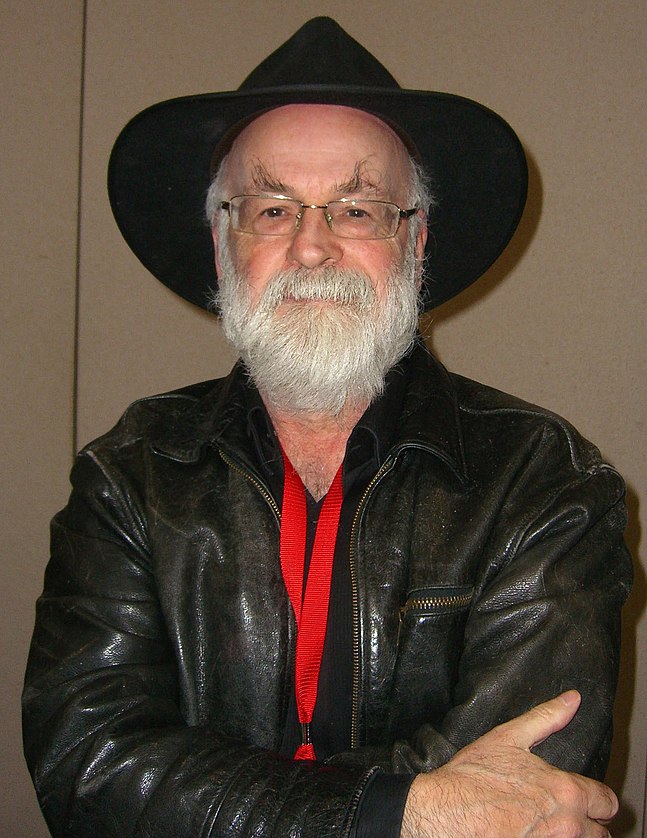
Upon the death of Sir Terry Pratchett

Image from Wikipedia
As many of you may be aware, the author of the Discworld series, Sir Terry Pratchett, died today from a severe chest infection and complications from early onset Alzheimer's disease. Sir Pratchett made a very large contribution to the body of work that is known as fantasy literature. (If you have not read his work, I highly recommend it. Wee Free Men is a favorite of mine.) His not so subtle commentary upon current events through the lens of his work is impressive. His exemplary skill at world building and developing story arcs that span several books will be missed, surely.

I think, however, Sir Pratchett would not be pleased with the mourning that much of the fanbase and writerly community is entering into right now. He was a man with a great deal of anger at the injustices in the world. He was a man who used his novels as a vehicle to attempt to effect change in the world through the spreading of ideas. I suspect that Sir Pratchett would be furious to see hand wringing and flowery eulogies.

I believe, my friends, that the best way we might honor this man's truly impressive legacy is to pick up our pens and get to work. If we are not writers, that does not mean we escape the call to work for change in the world. Sir Terry Pratchett was a man who used his gifts to push the world towards being a better place, a more just place. Let us honor him not with tears and rituals of mourning, but with our honest effort to continue his fight to make this world a better place.

Sunday, March 1, 2015

The dirty side of medieval-esqe life.

Something that regularly irks me in fantasy novels that are set in medieval settings is the fact that they whitewash the world. This happens a lot in romance novels set in this period too. Enough so that it had become a running joke between my best friend and I, with her reminding me that castles were warm and cozy and I reminded her that heroes always had to be muscular males (which always made her laugh because she was in a gay relationship when this conversation came up and we were trying to determine what the ideal hero was supposed to be). The whitewashing of the dirtiness and generally disgusting parts of the past and settings that are based in it is a type of romanticism that I think the genre could do without.

One thing that I actually like about the A Song of Ice and Fire series (Game of Thrones is the first book and the title of the television show based off it.) is the fact that Geo. R.R. Martin does portray the ugliness of the world. He doesn't try to pain his setting as one that is free of the attendant difficulties of that period. In keeping the more unpleasant aspects of that era in the picture, he adds a greater level of realism to his work. Yes, we can tell someone that a peasant lives in a hovel with their animals. Unfortunately, the image that comes to mind is a clean dwelling with clean animals that basically stand around and look pretty. When the truth is the dwelling is going to be dirty from what the animals track in and if they void their bowels or bladder indoors (which had to happen from time to time just on the basis of probability and statistics). The truth is that the dwelling was poorly lit and poorly heated. The truth is that there were rodents in the rushes that thatched that hovel and rodents scurrying around in the living area of it as well. A peasant's hovel was not the clean pretty thing you see in children's books.

And castles had their share of problems. The list is a bit too long to slap up here but a cursory bit of research into how people lived in castles will show you that they were also dirty places and were terribly heated. It would tell you that they were dark because they were poorly lit and lacked natural light. It would tell you many, many things that would put all but the hardiest of medievalists off from the idea of wanting to stay in one for a night, let alone live in one. (For the record, I am one of those hardcore medievalists.) They were nothing like what Peter Jackson portrayed in the Lord of the Rings movies. The people were not half so clean and well fed. The list of ways that the fantasy stories get the history wrong is too long to present here and that's really not my goal.

I want to make a case for presenting all that ugly stuff. Every story requires a conflict. Too often, it is assumed that the conflict must come in the actions of characters opposing each other. When we look at history, we see that there is lots of conflict in the story of these people's lives. It came from their environment. It came from if they had the bare necessities for survival. It came from the dangers that were present at all times, be it those of rancid food (because food preservation was nowhere near as advanced as what we had in the 1800s, let alone today) or illness. I'm not talking about something as dramatic as the Black Death. Influenza killed people in those days. A bout of bronchitis could (and most likely did) prove lethal all on its own. Then incorporate the medical technology of the era and illness becomes even more horrifying. A simple case of the common cold could possibly kill you if you weren't lucky.

Some would say that conflict coming from things like the dangers of using an open pit latrine or food poisoning are not as interesting as the conflict that comes from two characters fighting. I would argue that in the hands of a skilled author, even a case of the common cold in modern times can become a conflict that would interest the audience and advance the plot of the story. I would furthermore argue that not taking these factors into consideration is doing yourself and your readers a disservice. It is messy and depressing to read the history of the eras we base our material in. The trade off of this work, however, is creating a world that draws your readers into the story.

That, my friends, is one of the goals of writing a book. We don't just want our audience to passively look at the words on the page and come away with a dry sense of what the story was about. We want to draw them into the story and present human elements that they can connect with. We want to have our readers come away from our stories having gained something. A good book may tell a technical marvel of storycraft. It may be an exemplary example of sentence construction and how to organize material on the page. All of that technical skill, however, falls flat if your reader is not engaged in the story. Take the time to write out the dirty details of the world your characters move in. It makes the experience more believable and real to the reader. And that will increase your chance of moving the reader to emotion and the imaginative envisioning of your story. The more senses you engage your readers in, the more they will remember your book.